Manufacturing Insights
Why Luxury Handbags Require Hand Saddle Stitching | OEM Bag Manufacturer
Discover why luxury leather bags need manual saddle stitching at 3D corners. Engineering insights on multi-ply thickness, zero deflection, and Shenzhen OEM sampling.
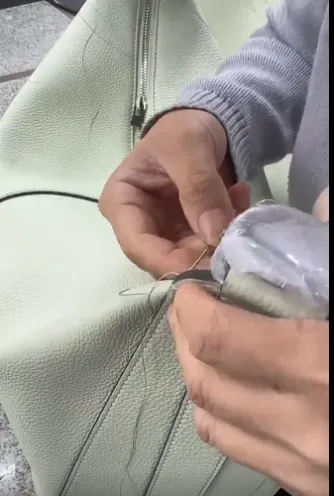
Why Luxury Handbags Still Demand Manual Saddle Stitching at the Perimeter Rim
Navigating 3D Corner Stress, 4.5 mm Multi-Layer Transitions, and Needle Shear at the Sample Bench
When luxury brand founders inspect a finished leather tote or structured Boston bag, visual focus naturally falls on the perimeter topstitching. If the needle lines look straight on a flat panel, the product is often presumed structurally sound.
In real-world leather goods engineering, however, the primary point of field failure is rarely the flat wall.
The structural risk concentrates at the 3D corner terminus where the top zipper closure, perimeter side gusset, and reinforced handle anchorage intersect.
Even with synchronized walking-foot post-bed machinery, mechanical needle feed systems encounter physical clearance limits when navigating these dense volumetric corners. Transitioning to manual double-needle saddle stitching at this specific apex is not an artisanal indulgence—it is a mandatory engineering safeguard.
1. Dynamic Shear Stress: Machine Lockstitch vs. Manual Saddle Loop
When a structured bag is packed to capacity with a laptop, documents, and daily hardware, kinetic drop-load force focuses directly onto the upper rim.
- Machine Lockstitch Vulnerability: Automated machines interlock an upper needle thread with a lower bobbin thread inside a single punched hole. If abrasion or dynamic shear breaks one thread, the entire seam run unzips under load. Furthermore, mechanical reverse back-tacking punches repeatedly through identical grain holes, micro-perforating and weakening the dermal fiber matrix.
- The Manual Saddle Solution: Hand-stitching uses two independent needles on a single continuous length of bonded thread. Every pass creates an interlocking friction knot inside the awl channel. Even if an exterior loop experiences friction abrasion, the opposing thread remains mechanically locked under internal tension.
2. Navigating Compound Thickness Steps (1.2 mm to 4.5mm)
At the corner junction of a structured bag, the artisan must traverse an abrupt multi-ply stack:
- Milled full-grain calfskin exterior (1.3mm)
- Structural microfiber edge reinforcement (0.45mm)
- Heavy-gauge metal zipper tape (0.8mm)
- Handle attachment core and bonded lining (1.2 mm)
Under high-speed machine feed, stepping abruptly from a 2-ply seam to a dense 5-ply stack triggers needle deflection, uneven stitch pitch (SPI), and bruised surface grain.
Executing these closing stitches by hand delivers two vital controls:
- Tactile Fiber Resistance: The craftsman gauges the physical yield of the grain by hand, applying balanced torque to seat the thread firmly into the edge crease without cutting surface fibers.
- Zero Needle Deflection: Pre-pricked diamond awl channels maintain an exact 3.38mm pitch, driving each stitch at a clean 45-degree slant without misaligned punctures.
3. Sub-Dermal Thread Burial & Edge Paint Integrity
How trailing threads are terminated dictates how an accessory ages over seasons of handling. External heat-melting leaves hard beads that crack edge finishes under temperature swings.
Our sample development protocol mandates a four-step terminal closure:
- Opposing Back-Stitch Lock: The final three passes are retraced under reverse tension, anchoring the thread frictionally against internal composite boards.
- Concealed Cavity Burial: Needles route trailing ends into the intermediate lining cavity rather than cutting flush along the raw edge.
- Beeswax Fiber Sealing: Wax-coated high-tensile threads compress tightly into awl channels, forming a sealed barrier against moisture ingress.
- Uncompressed Edge Coating: By closing the corner free from mechanical presser-foot clamping, the pre-finished edge paint retains its clean, unmarred contour.
The Hybrid Paradigm: Scalable Machine Fleet + Bench Precision
Global accessory brands scaling premium collections do not have to choose between unscalable 100% handcraft and rigid, fully automated assembly.
At our Shenzhen development workshop, we deploy precision CNC cutters and German post-bed sewing machines across flat, high-volume seams to ensure scale and uniform tolerances. But at critical 3D stress junctions where automated machinery hits physical boundaries, dedicated hand-bench expertise ensures long-term structural permanence.